
Toledo, OH · Garage Door Service
Why Toledo Garage Doors Break the Way They Do
Toledo's 1960s housing stock and cold winters mean torsion springs fail in predictable ways. Here's what's going on, what it costs, and when to call.
- Repairs & new doors
- Springs & openers
- Serving 5 nearby communities
What Is Going On
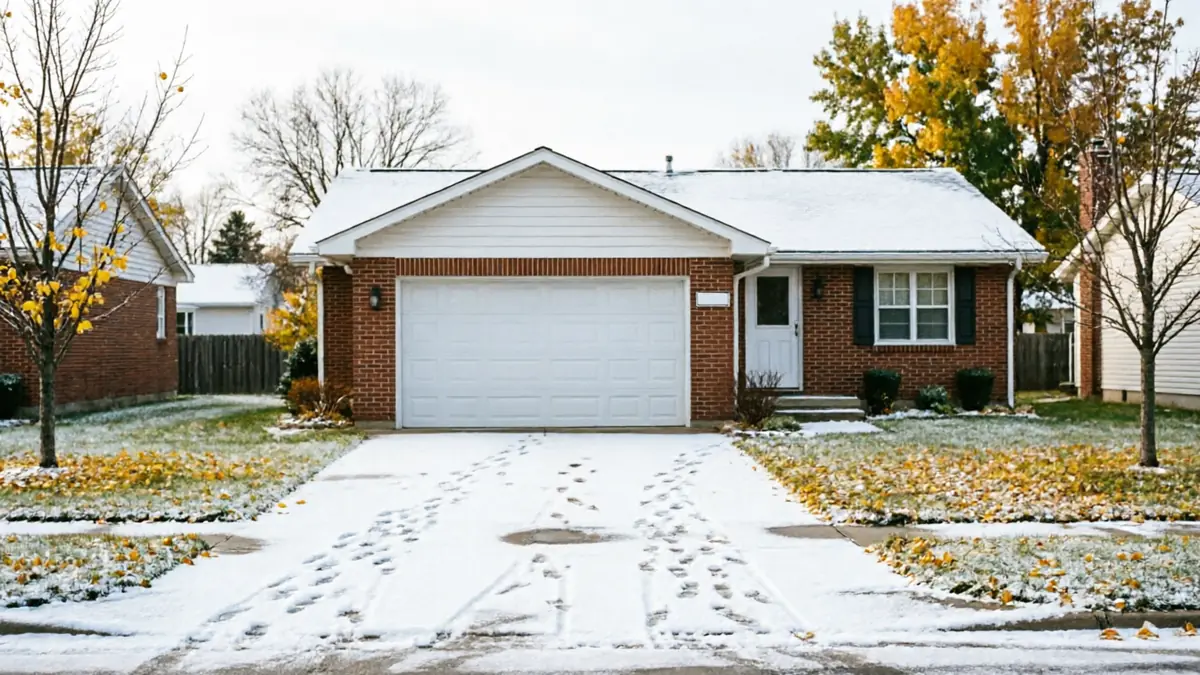
Most of the houses around here went up between 1938 and 1994, with the median sitting around 1966, and that one fact explains more service calls than anything else. A door built or retrofitted in the 1960s or 70s is running hardware that was never designed with today's heavier insulated panels in mind. The torsion spring on that original setup was sized for a lighter door, and over sixty-some years of cycling, metal fatigue catches up with it. In neighborhoods like Ottawa Hills, Rossford, Northwood, Holland, and the older pockets closer to the city - Five Points, DeVeaux, Warren Sherman - you'll still find original side-mounted torsion springs that nobody has touched since the Nixon administration. When one of those finally lets go, it's rarely a surprise to the spring. It's been winding down toward failure since it was installed. What you notice is the door getting heavy to lift, then one morning it won't lift at all, or it slams down because the spring snapped mid-cycle. That's not bad luck. That's a 60-year-old spring doing exactly what 60-year-old springs do.</p><p>The second piece is what sits on top of that old hardware: panels, tracks, and rollers that have usually been swapped out once or twice over the decades, often without upgrading the spring sizing to match. That mismatch is common enough that it's worth checking first before assuming the spring itself is just worn out.
How Local Conditions Play In
Toledo sits in a cold-severe climate band, and that matters more for garage doors than people expect. Steel contracts in cold weather, and a torsion spring that's already fatigued from decades of cycling has less give left in it when the temperature drops. That's why a spring that's limped along fine all summer will often go in January or February, usually on the first really cold morning after a stretch of mild weather - the metal doesn't flex the way it did when it was new, and the cold takes away what little flexibility is left.
Cold also stiffens the grease in old rollers and bearings, which means the opener has to work harder to pull a door that's already fighting a weakening spring. On older one-piece and sectional doors from that 1960s-70s stock, the combination of brittle hardware and cold-stiffened moving parts is the most common reason we see doors come off track or openers burn out gears in the dead of winter. None of this is exotic. It's just old metal meeting cold weather, over and over, until something gives.
What You Pay
We don't have a flat number to quote here, because what a job costs depends on whether it's a standard torsion spring swap or a full rebuild of hardware that's been mismatched over the years, and that's something we can only tell after we look at the door. What we can say is that spring replacement is almost always cheaper than letting a broken spring force a motor burnout or a cable snap, which tends to happen when people keep opening a door manually after the spring goes and the opener tries to compensate.
Across the service area's 49,228 households, 27,313 of those are owner-occupied houses, and with a median household income of $79,167 here, most of the repair work we do is a straightforward spring or opener fix rather than a full door replacement. Replacement makes more sense when the door itself is original to a 1960s build and the panels are rusted or warped beyond what hardware repair can fix - at that point you're paying to patch something that's going to need the same work again in a year or two.
When to Call Someone
Call before the spring fully snaps if you can catch it: a door that's gotten noticeably heavier to lift by hand, or an opener that strains and groans partway through a cycle, is usually a spring on its way out, not a settled problem. Waiting on that almost always costs more once the spring lets go completely, because a broken spring under tension can bend track or damage a panel on its way down.
If the door won't move at all, or it's come off the track, stop trying to force it with the opener - that's how cables get pulled or drums get bent, and it turns a spring job into a bigger repair. We work across the Toledo area, from Ottawa Hills and Maumee out to Perrysburg and Waterville, and the pattern holds pretty much everywhere: cold weather finds the weak point in old hardware. If your door is original to a house built before the 90s and you haven't had the spring looked at, that's worth a call before winter does it for you.
Frequently asked questions
Why did my spring break overnight with no warning?
It almost never happens with no warning - the spring has usually been weakening for years from normal cycling. Cold snaps are when the last bit of flex in fatigued steel finally gives out, which is why so many springs here fail on the first hard cold morning rather than gradually.
Is my old torsion spring the wrong size for my door?
It's common on houses from the 1960s and 70s where panels or openers were replaced over the years without resizing the spring. A mismatched spring wears out faster and strains the opener. We check the sizing against your actual door weight before replacing it.
Should I replace the whole door or just fix the spring?
If the panels and track are sound, a spring swap is almost always the cheaper and more sensible call. Replacement starts making sense when the door itself is original, rusted, or warped - at that point hardware repairs are just delaying the same failure.
Related garage door services in Toledo
More garage door guides
Book garage door service in Toledo
Call now or request a quote - tell us what the door is doing and where you are.