
Toledo, OH · Garage Door Service
What Your Toledo Garage Door Is Actually Dealing With
Toledo homes mostly went up between 1938 and 1994, median 1966, built before modern insulation codes. Here's how that and our cold winters affect your door and spring.
- Repairs & new doors
- Springs & openers
- Serving 5 nearby communities
What Is Going On
Most of the housing stock in this service area was built between 1938 and 1994, with the median landing around 1966. That matters more than people think. A door hung in 1966 was hung before anyone worried much about air sealing or insulated panels, and a lot of those original openings are still framed to the dimensions and tolerances of that era, even if the door itself has been swapped once or twice since.
Across the 19 named areas we work in - Ottawa Hills, Rossford, Northwood, Holland, Walbridge, Oregon, Sylvania, Maumee, Perrysburg and the rest - the pattern repeats: 1960s and 70s construction dominates. That means steel jambs that have shifted slightly over fifty-plus years, tracks mounted to studs that aren't quite where a new install would put them, and openers from three or four generations of hardware all still in service somewhere on the same street. When we get a call, we're rarely dealing with a blank slate. We're dealing with a door system that's been patched, replaced in pieces, or adapted to an opening that predates the part now sitting in it.
How Local Conditions Play In
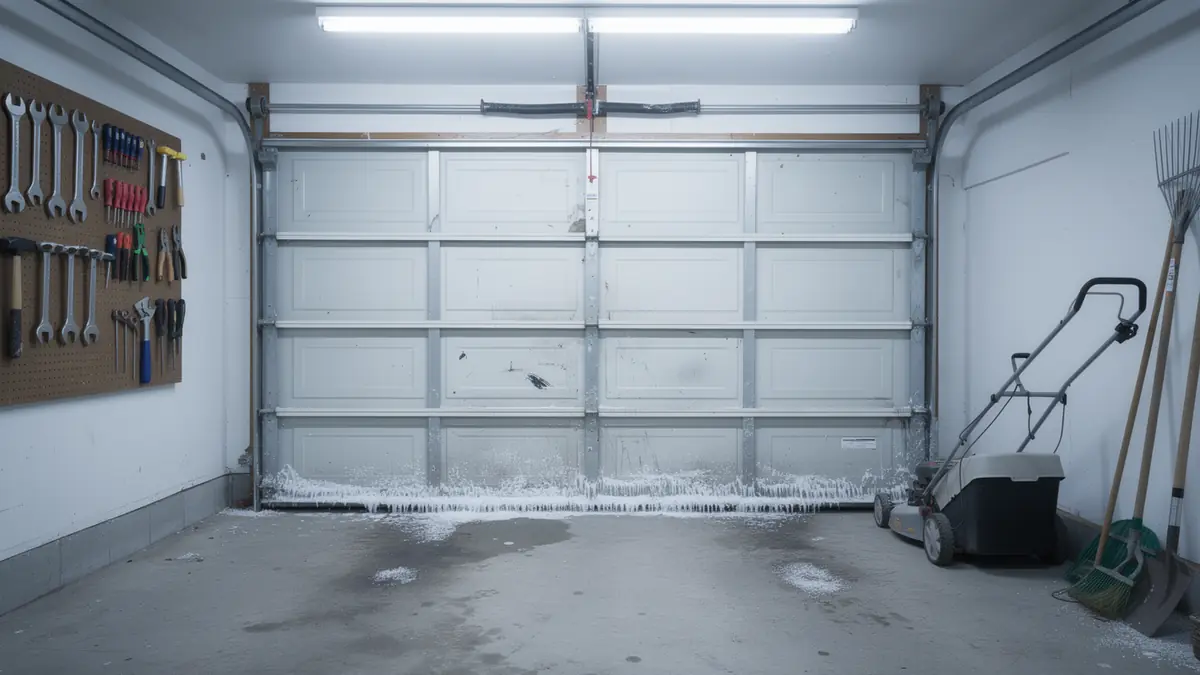
This is a cold-climate service area, and the cold here is rated severe, not mild. That changes what breaks and when. Steel contracts in low temperatures, and a torsion spring that's been fine all fall will lose tension and snap the first hard cold snap of the year - usually on the coldest morning, which is its own kind of bad luck.
It also changes what the doors built during that 1938-1994 window were never designed for. Insulation standards for garage doors weren't part of the code when most of this housing went up, so a lot of original or early-replacement doors are single-layer steel with no thermal break. On an attached garage, that's a wall of your house with almost no R-value, and in a severe-cold winter the temperature swing between outside and inside that garage can be enough to make rollers stiffen, lubricant thicken, and cables run rough through the drum. None of this is dramatic failure - it's slow wear that shows up as noise, then drag, then a stuck door on the one morning you need it to open.
What You Pay
We don't post a price list here because the honest answer is that it depends on what's actually wrong - a broken spring on a standard double door is a different job from a bent track on an opening that's out of square because the house has settled since 1966, and those two jobs don't cost the same. What we can tell you is what drives the number: the age and type of spring system, whether the opener is original equipment or a later add-on, and whether the track or jamb needs to be brought back into alignment before a new panel will even seat right.
Median household income across this area runs around $79,167, and we price jobs with that in mind - we're not going to sell someone a full replacement when a spring and a tune-up will carry the door another decade. If a door is original to a house built in the 1960s, replacement parts sometimes have to be special-ordered rather than pulled off a truck, and that adds time, not just cost. We'll tell you up front if that's the case rather than let you find out at the end.
When to Call Someone
Call now if the spring has already let go - a snapped torsion spring on a double door is not a weekend project, and trying to force the door open with the opener can burn out the motor or bend the track further. Call soon, not urgently, if you're hearing a grinding or popping sound that wasn't there last month; on houses from the 1960s and 70s stock common here, that's often a roller or bearing that's finally worn through after decades of service, and it's cheaper to replace before it takes the track with it.
One thing we won't do is talk you into a full door replacement when the problem is really the opener or a worn weatherstrip - on a lot of these older openings, the door itself is sound and a repair is the right call. Replacement makes sense when the panel is rusted through, the insulation is doing nothing in a severe winter, or the frame has shifted enough that no adjustment will keep it sealed. Short of that, we'd rather fix what's there.
Frequently asked questions
Why did my spring break overnight with no warning?
Torsion springs are rated for a set number of cycles, and cold steel is more brittle than warm steel. In this area's severe winters, a spring near the end of its life often lets go on the first sharp cold snap rather than failing gradually, because the metal has less give at low temperatures.
Is my garage door original to the house?
If your house was built in the 1960s or 70s, which covers a large share of homes in this area, it's possible the opening is original even if the door panel has been replaced once since. Original jambs and tracks from that era are often slightly out of the dimensions a new standard door expects.
Should I replace or repair an old uninsulated door?
Depends on condition, not just age. If the panel and track are sound, adding weatherstripping and a tune-up can carry you through more winters. If the steel is rusted or the frame has shifted, a repair won't hold in severe cold and replacement is the better money.
Related garage door services in Toledo
More garage door guides
Book garage door service in Toledo
Call now or request a quote - tell us what the door is doing and where you are.